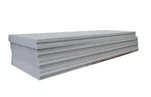
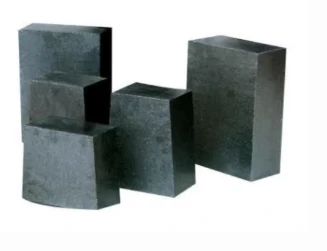
Magnesium carbon brick is made from high melting point alkaline oxide magnesium oxide (melting point 2800 ℃) and high melting point carbon material that is difficult to be infiltrated by slag, with various non oxide additives added. A non burning carbon composite refractory material made by combining carbonaceous binders. Magnesia carbon bricks are mainly used for lining converters, AC arc furnaces, DC arc furnaces, slag lines in steel ladles, and other parts.
Magnesia carbon brick, as a composite refractory material, effectively utilizes the strong slag erosion resistance of magnesia sand and the high thermal conductivity and low expansion of carbon, compensating for the biggest disadvantage of poor spalling resistance of magnesia sand.
Its main characteristics include: good high temperature resistance, strong slag resistance, good thermal shock resistance, and low high-temperature creep.
Production process
Raw material
The main raw materials for MgO-C bricks include fused or sintered magnesia, flake graphite, organic binders, and antioxidants.
Magnesia sand
Magnesia sand is the main raw material for producing MgO-C bricks, which can be divided into fused magnesia and sintered magnesia. Compared with sintered magnesia, fused magnesia has the advantages of coarse spinel grains and high particle volume density, and is the main raw material used in the production of magnesia carbon bricks. To produce ordinary magnesia refractory materials, the main requirements for magnesia raw materials are high temperature strength and corrosion resistance. Therefore, attention is paid to the purity of magnesia and the C/S ratio and B2O3 content in its chemical composition. With the development of metallurgical industry, the smelting conditions are becoming increasingly stringent. The magnesia used in MgO-C bricks applied in metallurgical equipment (converters, electric furnaces, ladles, etc.) not only requires high density and large crystallinity in terms of chemical composition, but also in terms of organizational structure.
Carbon source
Whether in traditional MgO-C bricks or widely used low-carbon MgO-C bricks, flake graphite is mainly used as its carbon source. Graphite, as the main raw material for producing MgO-C bricks, mainly benefits from its excellent physical properties: ① non wettability to slag. ② High thermal conductivity. ③ Low thermal expansion. In addition, graphite and refractory materials do not undergo eutectic at high temperatures, resulting in high refractoriness. The purity of graphite has a significant impact on the performance of MgO-C bricks. Generally, graphite with a carbon content greater than 95%, preferably greater than 98%, should be used.
In addition to graphite, carbon black is also commonly used in the production of magnesia carbon bricks. Carbon black is a highly dispersed black powdery carbonaceous material produced by the thermal decomposition or incomplete combustion of hydrocarbons. The carbon black particles are small (less than 1 μ m), with a large specific surface area, a carbon mass fraction of 90-99%, high purity, high powder resistivity, high thermal stability, and low thermal conductivity, making it difficult to graphitize carbon. The addition of carbon black can effectively improve the anti stripping properties of MgO-C bricks, increase the residual carbon content, and increase the density of the bricks.
Binder
The commonly used binders for producing MgO-C bricks include coal tar, coal tar pitch, petroleum asphalt, as well as special carbonaceous resins, polyols, asphalt modified phenolic resins, synthetic resins, etc. There are several types of binders used:
1) Asphalt substances. Tar asphalt is a thermoplastic material with high affinity for graphite and magnesium oxide, high residual carbon rate after carbonization, and low cost. It has been widely used in the past; However, tar pitch contains carcinogenic aromatic hydrocarbons, especially high levels of benzo [b] pyrene; Due to the strengthening of environmental awareness, the use of tar pitch is decreasing now.
2) Resin based substances. Synthetic resin is produced by the reaction of phenol and formaldehyde, and can be well mixed with refractory particles at room temperature. After carbonization, the residual carbon rate is high, and it is currently the main binder used in the production of MgO-C bricks; But the glassy network structure formed after carbonization is not ideal for the thermal shock resistance and oxidation resistance of refractory materials.
3) A substance obtained by modifying asphalt and resin. If the binder can form embedded structures and in-situ carbon fiber materials after carbonization, then this binder will improve the high-temperature performance of refractory materials.
Antioxidant
In order to improve the oxidation resistance of MgO-C bricks, small amounts of additives are often added. Common additives include Si, Al, Mg, Al Si, Al Mg, Al Mg Ca, Si Mg Ca, SiC, B4C, BN, and recently reported Al-B-C and Al-SiC-C systems. The principle of action of additives can be roughly divided into two aspects: on the one hand, from a thermodynamic perspective, that is, at the working temperature, additives or additives react with carbon to produce other substances, which have a higher affinity for oxygen than carbon and oxygen, and take priority over carbon oxidation to protect carbon; On the other hand, from a kinetic perspective, additives can react with O2, CO, or carbon to produce compounds that alter the microstructure of carbon composite refractory materials, such as increasing density, blocking pores, and hindering the diffusion of oxygen and reaction products.