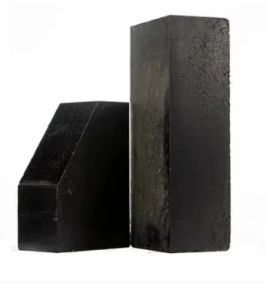
Preparation method of aluminum carbon brick
In the selection of raw materials, special grade and first-class alumina clinker are mainly used for refractory aggregates and powders, and materials such as white corundum and brown corundum can also be used; Carbon materials mainly use flake graphite, as well as medium temperature asphalt, etc; Silicon carbide can be of special grade or first grade, or dense SiC can be used; Phenolic resin is used as the binder, with a solid content of ≥ 75%, free phenol ≤ 6%, residual carbon content ≥ 43%, moisture content ≤ 2%, and density of about 1.1g/cm ³. The general mix ratio is 40%~60% for coarse aggregate, 5%~20% for fine aggregate, and 8%~15% for flake graphite SiC4%~10%, Refractory powder 15%~25% and binder 4%~6%, with additional additives such as ultrafine powder, alkali resistant agent, and expansion agent added as needed.
According to the production process, aluminum carbon refractory materials can be divided into two categories: non fired aluminum carbon refractory materials and fired aluminum carbon refractory materials. Aluminum carbon bricks include two types: Al2O3-C bricks and Al2O3-SiC-C bricks. Al2O3-C bricks are fired at high temperatures, known as Al2O3-C bricks, while Al2O3-SiC-C bricks are unburned bricks that have not been fired at high temperatures.
The key process points for manufacturing fired aluminum carbon bricks are: adding carbon raw materials to the main raw materials of alumina, and adding a small amount of other raw materials such as silicon powder, SiC powder, aluminum powder, etc., using phenolic resin or asphalt as a binder, through batching, mixing, isostatic pressing or machine pressing, and firing in a reducing atmosphere.
The key process points for manufacturing non fired aluminum carbon bricks are the same as non fired bricks. Al2O3-SiC-C bricks are non fired bricks that have not been fired at high temperatures.
Application field
Aluminum carbon bricks are mainly used as sliding nozzle slides, integral plug rods for continuous casting intermediate ladle, and can also be used as liners for molten iron pretreatment and steel ladle liners. They are suitable for high aluminum furnace waist, belly, cooling wall aluminum bricks and other parts with different furnace capacities.
Burned aluminum carbon bricks are widely used as sliding nozzle slides, long nozzles, immersion nozzle upper and lower outlet bricks, and integral plug rods for continuous casting; Non fired aluminum carbon bricks have been widely used in iron pretreatment equipment due to their superior oxidation resistance compared to magnesium carbon bricks and excellent resistance to Na2O slag erosion.
In recent years, aluminum carbon bricks have been used as lining materials for blast furnaces. As a replacement material, their performance is different from traditional refractory bricks and their cost has also changed.
In blast furnaces, aluminum carbon bricks are commonly used in the belly, waist, lower and middle parts of the furnace as a substitute for Si3N4 combined with SiC bricks due to their thermal shock resistance and certain anti erosion ability.