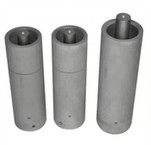
What is Alumina-Magnesia Refractory Castable?
Alumina-magnesia refractory castable is a refractory material formulated with fused magnesia, sintered magnesia, fused or sintered magnesium-aluminate spinel, etc. as main raw materials. According to the quality of raw materials, it can be divided into various types such as ordinary alumina-magnesia, high-alumina spinel, and alumina-magnesia.
This material is mainly used for the monolithic lining of continuous casting steel ladles, and is also suitable for tundish permanent linings and electric furnace tapping trough linings. It possesses excellent high-temperature strength, creep resistance, thermal shock resistance, high service temperature, and strong resistance to basic slag. In the material, the in-situ formation of magnesium-aluminate spinel affects its performance. For example, as the addition amount of fused magnesia fine powder increases, the resulting in-situ magnesium-aluminate spinel causes an increase in micro-cracks.
Physicochemical Properties of Alumina-Magnesia Refractory Castable
The physicochemical properties of alumina-magnesia refractory castable, such as bulk density, strength, porosity, thermal shock resistance and thermal properties, are significantly influenced by the raw material ratios and heat treatment conditions. Studies have shown that the addition amounts of cement and magnesia fine powder affect the in-situ formation of spinel: a larger amount of MgO fine powder can promote the formation of spinel, while also achieving better permanent linear change, but the cement content should not be too high. Considering both spinel formation and permanent linear change, suitable ratios are 3% cement with 50% MgO fine powder, or 4% cement with 34% MgO fine powder, with a total MgO addition of 6%. The Al₂O₃ content of spinel generally increases with the firing temperature. The addition amount of fused magnesia fine powder also has a significant impact on performance: as the addition amount of fused magnesia fine powder increases, the bulk density, flexural strength and compressive strength of the specimens gradually decrease, while the apparent porosity gradually increases; thermal shock resistance increases, and high-temperature flexural strength decreases somewhat. This is mainly due to the increased micro-cracks caused by the generation of in-situ magnesium-aluminate spinel as the fused magnesia addition increases. In addition, the content of silica fume also has a significant effect on performance: under heat treatment conditions of 1773K and 1373K, with the increase of silica fume content, the bulk density and compressive/flexural strength of the specimens show a trend of first increasing and then decreasing, while the apparent porosity shows a trend of first decreasing and then increasing; below 873K, the thermal conductivity of the alumina-magnesia castable increases with silica fume content. Taking all performance requirements into consideration, a suitable silica fume content is 3%–4%.
Preparation Method of Alumina-Magnesia Refractory Castable
One preparation method for alumina-magnesia refractory castable uses raw materials in the following weight percentage ratios: corundum aggregate and fine powder 70–80%, alumina micro powder 5–15%, magnesia-containing material 2–10%, binder 3–8%, silica fume 0.3–1.5%, organic fibers (added) 0.05–0.1%, water reducer (added) 0.2–0.6%. The preparation process includes batching, mixing, forming, curing, drying and other steps. This castable has high thermal shock resistance.
A new type of high-temperature resistant, high-strength alumina-magnesia castable uses a magnesium-silicon-water bonding system instead of the traditional cement bonding system and hydratable alumina bonding system. Its raw materials include high-alumina aggregate with a particle size >0.15mm (60–75%) and particle size dispersant.