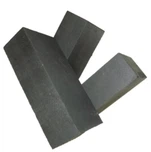
(1) Refractory brick lining is divided into four categories according to the size of the brick joint and the fineness of operation.
Its category and brick joint size are: Class I, ≤0.5mm: Class II, ≤1mm, Class III, ≤2mm: Class IV, ≤3mm.
When the refractory lining of the cement rotary kiln system is built with fire mud, the gray joint should be within 2 mm. If the design is not indicated, the masonry may be carried out according to the above recommended level, and the construction shall be strictly controlled. The ash seam in the lining of the stationary equipment should be full and the brick joints in the inner and outer layers of the upper and lower layers should be staggered.
(2) The following principles shall be followed for the preparation of refractory mud for bricklaying.
1 Pre-experiment and pre-laying of various refractory muds before bricklaying. Determine the bonding time, initial setting time, consistency and water consumption of different muds.
2 Different muds should be used to prepare different muds and cleaned in time.
3 To prepare different quality muds, use clean water. The amount of water should be weighed accurately, and the mixture should be evenly distributed. The hydraulic and gas-hard mud that has been prepared must not be used with water. The mud that has been initially set up must not be used.
4 When modulating the phosphate combined with the mud, it is necessary to ensure the specified trapping time, and the prepared mud can not be diluted with water by any means. This mud is not corrosive and must not be in direct contact with the metal casing.
(3) The variety and layout of refractory bricks are built according to the design plan.
Generally, the dome and the cylinder lining should be built with ring peaks. Straight walls and slopes should be made of staggered joints. When laying, the bricks should be straight, the curved surface should be smooth, and the masonry should be dense. For the refractory lining of the kiln tube, it must also ensure that the brick ring and the kiln tube are reliably concentric. Therefore, the refractory brick surface should be completely in close contact with the kiln cylinder. The bricks should be in surface contact and firmly combined. When the brick lining of the non-moving equipment is built, the fullness requirement of the fire mud is over 95%, and the surface brick joint is to be seamed with the original slurry, but the excess mud on the surface of the brick lining should be scraped off in time.
(4) Use flexible tools such as wooden hammers, rubber hammers or hard plastic hammers when laying bricks. Do not use steel hammers.
(5) When building refractory and heat-insulating lining, it is necessary to avoid the following common problems.
1 misalignment: that is, the unevenness between layers and layers, between blocks.
2 tilt: that is uneven in the horizontal direction
3 uneven gray seam: that is, the width of the gray seam is different, which can be adjusted by appropriate brick selection.
4 Hill climbing: that is, the phenomenon of regular unevenness on the surface of the ring wall should be controlled within 1mm.
5 Separation: In the arc masonry, the brick ring is not concentric with the casing.
6 Reunion: The upper and lower layers of gray seams are superimposed, and only one gray seam is allowed between the two layers.
7 through seams: that is, the internal and external horizontal layer of gray joints and even the metal shell is not allowed.
8 mouths: that is, in the arc-shaped masonry, the small and large inside the gray seam.
9 Void: That is, the mortar is not full between the layers, between the bricks and between the shells, and is not allowed in the lining of the uncertain equipment.
10 hair seams: the brick joints are not hooked and the walls are not clean.
11 serpentine bend: that is, the longitudinal slit, the ring peak or the horizontal slit is not straight, but is curved in a wave shape.
12 Masonry drum kit: It belongs to the deformation of the equipment, and should be used to level the surface of the equipment during the masonry. Leveling with insulation when laying double lining
13 mixing: wrong use of mud, is not allowed
(6) Refractory and heat-insulating composite lining for masonry and non-moving equipment, it is necessary to layer and section masonry, and it is strictly forbidden to mix mixed-laying masonry: masonry thermal insulation lining is also full of full seams, encountering holes and rivet weldments When processing bricks or boards, the gaps should be filled with mud. It is forbidden to arbitrarily paving, leaving voids or no mud. In the insulation layer, all the places under the anchor bricks and the angle bricks, around the holes and in contact with the expansion should be replaced with refractory bricks.
(7) The expansion joints in the refractory brick lining must be designed as designed and must not be missed. The width of the expansion joint should not be negatively toleranced. There should be no hard debris left in the joint, and the seam should be filled with refractory fiber to avoid the phenomenon of overfilling. Generally, there is no expansion joint in the heat insulation layer.
(8) Lining of important parts and complex parts should be carried out first. A lining that is structurally complex and that has a large amount of brick processing can be considered as a castable lining.
(9) The exposed metal parts left in the brick lining, including the bricks, bricks and other parts, should be closed with special-shaped bricks, castables or refractory fibers, and should not be directly exposed to the hot kiln gas during use.
(10) Anchor bricks are structural bricks of masonry, which should be left in accordance with the design regulations and must not be missed. Cracked anchor bricks should not be used around the hanging holes. Metal hooks should be flat and hung. Hanging holes and hooks cannot be stuck, and the gap left can be filled with refractory fibers.
(11) When bricklaying capping, street turning and cornering bricks, if the original brick can not meet the requirements of the tuyere, the brick should be finished with the brick cutting machine, and the manual processing brick should not be used. The size of the processing brick: in the rotation The topping bricks under the kiln and the bricks shall be not less than 70% of the original bricks: in the plane joint bricks and curved bricks, not less than 1/2 of the original bricks, the original bricks must be locked, and the working faces of the bricks are strictly prohibited. machining.