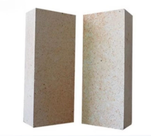
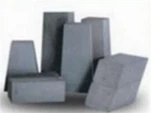
Factors that determine the wear resistance of refractory bricks Refractory bricks are widely used in many projects. In the furnace, refractory bricks are also embedded. The refractory bricks must not only meet the requirements of fire resistance and high temperature resistance, but also meet the requirements of wear resistance.
The wear resistance of refractory bricks is related to temperature. Some refractory bricks, such as high alumina bricks, are generally considered to be at a certain temperature (such as in the elastic range below 700-900 ° C). The higher the temperature, the lower the wear resistance, ie It can be considered that as the temperature increases, the wear resistance decreases as the modulus of elasticity of the refractory brick increases. When the temperature rises and reaches the maximum value of the elastic modulus, the wear resistance is improved as the modulus of elasticity decreases. For example, when the clay brick is at 1200 ~ 1350 ° C, the wear resistance is even better than normal temperature. When the temperature is further increased, the liquidus viscosity in the refractory product is drastically lowered as the temperature is above 1400 ° C, and the wear resistance is lowered. Some refractory bricks, such as chrome-containing refractory bricks, increase wear resistance with increasing temperature.
The wear resistance of the refractory brick depends on the composition and structure of the refractory brick. When the composition of the refractory brick is a dense polycrystal composed of a single crystal, the wear resistance mainly depends on the hardness of the mineral crystal of the constituent material. High hardness and high wear resistance of the material. When the mineral crystals are non-isotropic, the crystal grains are fine and the wear resistance of the material is high. When the material is composed of multiple phases, its wear resistance is directly related to the bulk density or porosity of the material, and also to the bonding strength between the components. Therefore, in the case of a certain kind of refractory brick at normal temperature, the wear resistance is proportional to its compressive strength, and the well-fired refractory brick has better wear resistance. The composition and structure of the refractory bricks, as well as the temperature, will affect the wear resistance, so that the wear resistance of the refractory bricks produced will be even better!