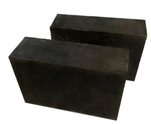
1) Crack inspection uses a steel ruler with a scale of 0.5 mm and a steel wire with a diameter equal to the measured crack width (for example: 0.1, 0.25, 0.5, 1.0 mm);
2) When checking the cracks of high alumina bricks, insert the steel wire into the width of the crack naturally. However, it should not be inserted into the place where the particles fall off visible to the naked eye; for any crack that cannot be inserted by a 0.25 mm steel wire, its width is expressed as less than 0.25 mm; for any 0.25 mm The width of cracks that can be inserted by steel wires but cannot be inserted by 0.5 mm steel wires shall be represented by 0.25-0.5 mm, and so on;
3) When the crack is not in a straight line, it can be measured in segments, and the sum of the lengths of each line segment is the total length of the crack; a crack (including unrestricted cracks) with interruptions in the middle and the interruption distance is less than 5 mm is a crack, and its length is combined to calculate , except for intersecting and parallel cracks;
4) Cross-edge cracks, except for special cases, shall be calculated as continuous cracks. A crack spanning both the working face and the non-working face shall be calculated according to the working face; cracks spanning two edges at the corners shall not exceed the provisions for missing corners. The range of values shall not be calculated as spanning two edges; any cracks within the limits specified in the standard shall not be limited by spanning edges and shall not be inspected;
5) Surfaces with grooves and convex edges are calculated as one surface, except for high-alumina bricks for casting; surfaces with through holes are calculated as two surfaces;
6) The high alumina bricks form thin and long straight line cracks due to improper cooling, which are cold cracks and should be treated as unqualified products;
7) Where several cracks form a closed curve, it is a network crack; when calculating the length of a network crack, the full length of the periphery shall prevail; if more than one crack intersects, it is a cross crack; when calculating the number of cross cracks , subject to the straight line crack;
8) Edges with an angle of 120 degrees are not counted as edges, and surfaces with a size less than 20 mm are not counted as surfaces, except for high-alumina bricks for casting.
We know that high-alumina brick is a common refractory material, and its refractoriness is very high. It is mainly used for the lining of blast furnaces, hot blast stoves, electric furnace tops, blast furnaces, reverberatory furnaces, and rotary kilns.