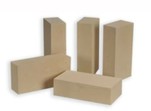
There are various types of industrial kilns built with refractory bricks, including glass kilns, steelmaking furnaces, ironmaking furnaces, and so on. As a part of industrial kilns, the furnace bottom has different requirements for this part in different kiln production environments. This has led to the market being flooded with various types of refractory bricks and ramming materials for furnace bottoms, which often make it difficult for people to start purchasing. Today, starting from common industrial kiln environments, we will take a look at those commonly used refractory bricks and ramming materials for furnace bottoms.
1. Heating furnace
The slag resistant castable at the bottom of the furnace is used for pouring the furnace bottom. The top of the third section of the heating furnace can be poured with the same material, or clay bonded castables or low cement clay castables can be used in the low temperature section, while higher strength low cement high alumina castables can be used for others. Insulation board or lightweight or medium quality casting material, with a thickness of about 50-100mm. The insulation layer cannot be too thick, otherwise it will lead to an increase in the softening layer and a weakening of the structural strength.
2. Electric furnace
Magnesium carbon permeable bricks and permeable ramming materials are commonly used for the bottom of electric furnaces, and dry ramming materials are often used for construction. Among them, magnesium calcium dry ramming material is mainly used, which has ceramic bonding, low silicon, high calcium, appropriate amount of iron, and a large amount of fine powder. It has the characteristics of thin sintering layer, dense sintering, high density, high thermal strength, good resistance to steel penetration, and volume stability. Different furnace types have different thicknesses of ramming materials for the furnace slope and bottom. During construction, the materials should be laid layer by layer, with each layer being 150mm thick. They should be compacted with foot and steel chisels to facilitate exhaust.
3. Coke oven bottom
The furnace bottom is composed of ordinary sticky bricks and high-strength insulation bricks. Before masonry, re measure the surface elevation of the foundation, make a record, and level it with cement mortar. When laying ordinary clay bricks and high-strength insulation bricks, they should be constructed in groups. Ordinary clay bricks should be laid first, followed by high-strength insulation bricks, and the mud should be full. When the elevation of the foundation bottom is low, the horizontal joints of ordinary clay bricks in the * * * masonry layer can be made of cement mortar of the same grade as the foundation leveling layer.
4. Carbon furnace bottom
Bottom clay brick section of carbon furnace: clay brick masonry at the bottom of the calcination tank. Clay bricks for carbon furnaces can also be used for the throat, body, hearth, bottom, and body of small blast furnaces and large blast furnaces; Hot blast stove, heat storage chamber, and partition wall. Clay bricks for hot blast stoves require good thermal shock resistance, high load softening temperature, and low creep.
As an indispensable part of most industrial kilns, the furnace bottom has a complex working environment and uses a variety of refractory bricks and ramming materials. Rongsheng Refractory reminds customers that when selecting refractory materials for the furnace bottom, they should be reasonably configured according to the actual production environment and built reasonably based on the properties of the refractory materials, so as to ensure the maximum service life of the furnace bottom refractory bricks and ramming materials.
Contact me:Email:wp@cnjingganrefractory.com/sdwenping@163.com
TEL: 86-0533-4188518 / FAX: 86-0533-4188518
Rose:+86-13275332819(wechat/whatsapp number)