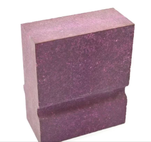
High alumina bricks usually refer to refractory bricks with Al2O3 content above 48%. They mainly take natural bauxite clinker as raw material, add soft or semi-soft clay as a binding agent, prepare a slurry, and shape and dry. , Fired a kind of refractory brick. The refractoriness of it is about 1770 degrees Celsius, and the load softening temperature is 1420°C-1550°C. It are mainly used for the lining of blast furnaces, hot blast stoves, electric furnace tops, blast furnaces, reverberatory furnaces, and rotary kilns.
According to the different content of Al2O3, it can be divided into three grade the (Al2O3 content between 48% and 60%) and second grade it (Al2O3 content between 48% and 60%) 60%) . %-75%) first-class high alumina brick (Al2O3 content above 75%) ultra high alumina brick (Al2O3 above 80%), according to the mineral composition can be divided into low mullite, mullite, mullite- Corundum quality, corundum mullite quality and corundum quality.
Characteristics of high alumina bricks:
1. High load softening temperature. Due to the high content of Al2O3 in high-aluminum products, the content of impurities is low, and the softening temperature under load is high, ranging from 1420°C to 1550°C. However, since mullite crystals do not form a network structure, the softening temperature under load is still not as high as that of silica bricks.
2. Anti-slag type. High alumina brick contains more Al2O3, which is close to neutral refractory material, so it can resist the erosion of acid slag and alkaline slag. Because it also contains SiO2, the ability to resist alkaline slag is weaker than that of acid slag. .
3. Refractoriness. The fire resistance of it is higher than that of clay bricks and semi-silica bricks, reaching 1750~1790℃, which is a refractory material.