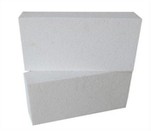
Refractory bricks are abbreviated as fire bricks. Refractory materials made by firing refractory clay or other refractory materials.
Light yellow or brownish in color.
Refractory bricks are mainly used for building smelting furnaces, capable of withstanding high temperatures ranging from 1580 ℃ to 1770 ℃.
Refractory bricks are also known as fire bricks. Refractory materials with a certain shape and size. According to the preparation process, it can be divided into fired bricks, unburned bricks, electric melting bricks (cast bricks), and refractory insulation bricks; According to shape and size, refractory bricks can be divided into standard bricks, ordinary bricks, special bricks, etc. High temperature building materials and structural materials that can be used as building kilns and various thermal equipment, and can withstand various physical and chemical changes and mechanical effects at high temperatures. For example, refractory clay bricks, high alumina bricks, silica bricks, magnesia bricks, etc.
Characteristic of refractory bricks
1. Chemical composition: The main components determine the quality and characteristics of the refractory material
2. Volume density: unit volume weight, high density, indicating good density, strength may be high, but thermal conductivity may be high. 3. Visible porosity: No specific requirements have been made, but as a manufacturer, it is necessary to strictly control visible porosity.
4. Load softening temperature: also known as the temperature at which high-temperature loads begin to deform. This parameter is important and indicates the material's ability to resist high temperatures
5. Thermal shock resistance: the ability to withstand rapid temperature changes without being damaged
6. Compressive strength: the maximum pressure capacity that can withstand (at room temperature)
7. Flexural strength: the ability to withstand shear pressure
8. Linear rate of change: also known as re burning line change or residual line change, refers to the change in volume expansion and contraction at the same temperature each time. If the expansion and contraction are the same each time, we define this linear rate of change as 0
Physical and chemical properties of refractory bricks
1. Wear resistance:
2. Thermal conductivity: Under the condition of unit temperature gradient, the heat flux rate per unit area of the material is related to the porosity
3. Impact resistance: No need to explain, good impact resistance means long service life
4. Slag resistance: the ability to resist the erosion of slag at high temperatures without being damaged.
Do you want to find a professional supplier?
Do you want to find a stable and credible supplier?
Then please contact with us.
Contact me:
Email:wp@cnjingganrefractory.com/sdwenping@163.com
TEL: 86-0533-4188518 / FAX: 86-0533-4188518
Rose:+86-13275332819(wechat/whatsapp number)