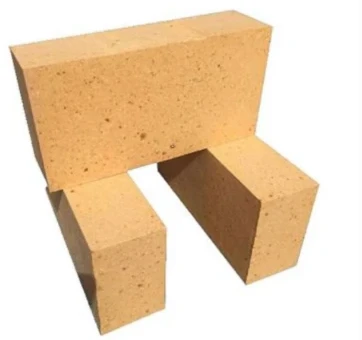
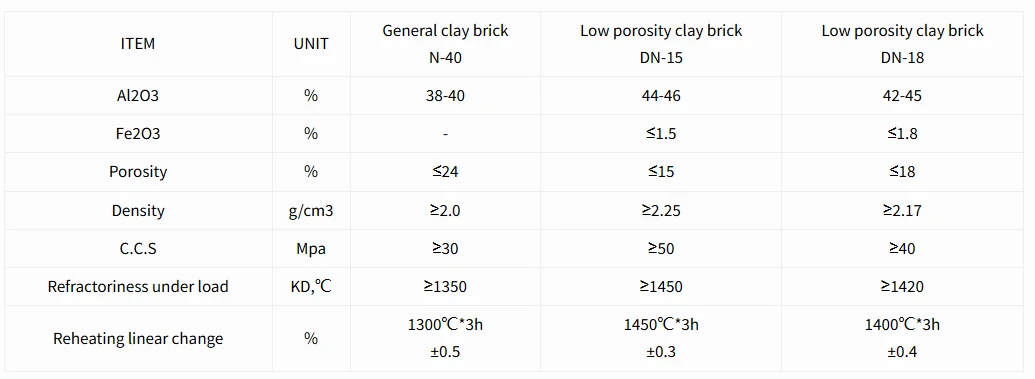
Low porosity clay bricks belong to refractory materials, and their preparation methods include using raw materials such as coarse powder of pyroxene, secondary alumina vanadium clay, 70 mullite fine powder, primary alumina vanadium clay fine powder, clay fine powder, etc.
Low porosity clay bricks are made from coarse powder of pyrophyllite, secondary alumina vanadium clay, fine powder of 70 mullite, fine powder of primary alumina vanadium clay, and fine powder of clay.
During the preparation process, the pulp liquid is sieved and diluted with water below 22 mesh to avoid the formation of mud lumps and the formation of caves in the bricks after firing; After refining the slurry with a mesh size higher than 22, it is used for impregnating the green product after one baking, forming non agglomerated small molecules. The fine fibers in the slurry are redistributed in the pore structure of the green product under high-temperature roasting, increasing the bulk density of the green product and further densifying its internal structure; The billet is roasted and dried multiple times in the slurry to ensure good grafting and form fiber reinforcement, avoiding cracks during shrinkage; By final sintering, the FeO content is reduced, the volume shrinks, and the clay appears as a glassy liquid phase, filling the voids of unmelted particles.
Low porosity clay bricks are made from coarse powder of pyrophyllite, secondary alumina vanadium clay, fine powder of 70 mullite, fine powder of primary alumina vanadium clay, and fine powder of clay. During the preparation process, the pulp liquid is sieved, and the portion below 22 mesh is diluted with water and mixed with the powder to avoid the formation of mud lumps; After refining the slurry above 22 mesh, it is used for impregnating the raw products after one baking. The refined slurry forms non agglomerated small molecules, and the fine fibers in the slurry are redistributed in the pore structure of the billet under high-temperature calcination, increasing the bulk density of the billet and further densifying its internal structure. The billet is roasted and dried multiple times in the slurry to ensure good grafting, form fiber reinforcement, and avoid cracking during shrinkage. By final sintering, the FeO content is reduced, the volume shrinks, and the clay appears as a glassy liquid phase, filling the voids of unmelted particles.