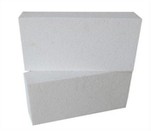
The mineral composition of high alumina refractory bricks can be divided into two major categories: main crystalline phase and matrix phase. The main crystalline phase is the main body of the high alumina brick structure, and in addition to the high melting point, it must also be fully developed and intact. The matrix is the filler between the main crystalline phases. The number is small, but the composition is complex and the effect is obvious. These two mineral compositions of high alumina bricks are indispensable.
Under the premise of fixed chemical composition of high alumina bricks, due to the homogeneity of composition distribution and processing technology, the minerals composed of high alumina brick products have different types, quantities, grain sizes and bonding states. The difference in structure results in a difference in performance of the refractory brick. For example, high alumina bricks and mullite high alumina bricks are basically the same in chemical composition, but their mineral compositions are different, so the normal temperature and high temperature performance of their products are quite different. Therefore, the mineral composition of high alumina bricks and the microstructure of high alumina bricks are also important factors in determining the properties of high alumina bricks.
Generally speaking, the structure of high alumina bricks is a heterogeneous body composed of solid matter and gaseous pores. Porosity is an important factor affecting the normal temperature and high temperature performance of the product, especially under high temperature conditions, the resistance of the product to external erosion is greatly reduced. The formation of the pores is difficult: the air in the material is not completely removed during the forming of the high-aluminum brick; the space is left after the material moisture is removed; the raw material is not fully calcined, and some of the salts to be decomposed are not completely decomposed, and the components to be burned are not completely burnt. Burning; the material composition is uneven, and the shrinkage is uneven when the temperature is high.
However, in the manufacture of some lightweight and heat-insulating high-aluminum bricks, some evenly distributed pores have been introduced. The existence of pores directly affects the porosity, water absorption, bulk density, and air permeability of high alumina bricks.