Mullite
Mullite mullite is the only stable crystalline phase from room temperature to high temperature in a1203si02 system at standard atmospheric pressure. Because mullite is placed in double chains, its crystal generally presents needle like and columnar structure. In some high alumina, especially electrofused mullite, it can form needle like mullite crystal network. Mullite is widely used because of its high time fire resistance, good thermal shock stability, low thermal expansion coefficient, good high temperature creep resistance, high wear resistance, peeling resistance and corrosion resistance.
Introduction to the functional features of bluestone mullite brick
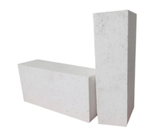
Cordierite in cordierite mullite brick has small thermal expansion coefficient (about 1 × 10⁻⁶ ~ 2 × 10⁻⁶ ℃ - 1 at 251000 ℃), good thermal resistance and chemical stability, but its fire resistance is low, and it will differentiate at 1470 ℃. Mullite has high fire resistance and high thermal expansion coefficient (4.5 × 10⁻⁶ ℃ - 1). It can be seen that the swelling coefficients of cordierite and mullite are quite different, which can cause microcracks in cordierite mullite bricks, which is beneficial to the thermal shock resistance of the data
Because the formation temperature and differentiation temperature of cordierite are close to each other. That is to say, the firing scale of cordierite is narrow, and there is no significant cordierite formation at lower temperature, while the higher firing temperature will lead to a lot of glass phase formation. Therefore, in order to reduce the glass phase and improve the thermal stability of mullite cordierite kiln furniture, cordierite and mullite are often used as raw materials in the production of mullite cordierite kiln furniture. In the molding machine, because the grouting molding can choose high-pressure grouting molding, machine pressure molding
(1) High fire resistance, thermal shock resistance and chemical stability. The modern kiln furniture with good chemical stability is not easy to react with the products.
(2) It has high strength at room temperature and high temperature. One of the effects of the compact is load-bearing, so it is necessary to fully bear the load of the products and the fixture itself. High strength materials can make the compacts light and thin, so as to improve the loading density and product quality
(3) Excellent thermal conductivity and low heat. The production of products tends to be high quality, high yield and low consumption
(4) The appearance is regular and the scale is accurate. The firing deformation of the product is related to sagger Flatness: the sagger scale is accurate, which is conducive to mechanized operation and improves production efficiency
Application of cordierite mullite brick
The incinerator of hot blast stove is used to mix gas and air and send it to the incineration room. Generally, it is required to have enough incineration energy to shorten the burning period, ensure that the gas and air are mixed evenly and can be burned stably, so as to avoid the phenomenon of back injection. Cordierite mullite brick is the traditional brick used in domestic ceramic incinerator. Now, red cornerstone mullite, high alumina Lapis brick and mullite cordierite brick are used
In recent years, a new generation of cordierite mullite brick for ceramic incinerator has been developed by using Sanshi, which has better physical and chemical functions, especially thermal shock resistance. Cordierite mullite brick industry standard for ceramic incinerator of hot blast stove has two requirements (rt-information and RT-B) for thermal shock resistance (1100 ℃, water cooling), which are not less than 40 times and not less than 70 times respectively. The production of these bricks requires the use of three stone mineral deposits, especially the red cornerstone mine. For the top burning hot blast stove, the air temperature of the ceramic incinerator is higher (about 1360 ℃), which requires more thermal shock resistance
It is shown in the test conditions and the number of thermal shock stability. Water cooling at 1300 ℃ was originally required, but now it is required to be water-cooled at 1100 ℃. The seismic stability is not less than 100 times